









Once his black-and-white portrait hung in every intelligent “Khrushchyovka”. Sweater, gray beard, squinting gaze. Hunter of lions, hunter of fish and beautiful women, ultimately — of himself.
Hunter of lions, hunter of fish and beautiful women, ultimately — of himself. Ernest Hemingway. This name has a smell. It smells of salt and snow. It smells of blood, sadness, and also happiness. Because now we know for sure — a person cannot be defeated. This writer influenced several generations of people more than sometimes their parents did…
In 1956, arriving in Paris, Hemingway received an unexpected gift at the “Ritz” hotel, where he often stayed in his youth. In the hotel basement, two suitcases belonging to the writer were discovered, which had been stored there since the late 1920s. They contained his notebooks and manuscripts, which he himself thought were lost… Going through them, Hemingway recalled the years of his youth and life in Paris. He later confessed to his wife Mary Welsh: “It’s amazing, but it turns out that back then it was just as hard for me to work as it is today.” And he decides to write about his life in the 1920s. He will call his memories of Paris “A Moveable Feast.”
Ernest Hemingway lived in Paris from 1921 to 1923, still being an unknown journalist. This city made a stunning impression on the American writer Sherwood Anderson, with whom young Ernest was friends. Upon returning, he recounted that when he first saw Paris through the misty haze, he cried with joy. His excited stories about Paris stirred Hemingway’s soul, intensifying his desire to leave America for Paris.
On December 8, 1921, Ernest and his first wife Hadley Richardson sailed from New York to Europe on the steamship “Leopoldina.” At first, they were so captivated by the city that they didn’t even have time to send the recommendation letters that Sherwood Anderson had provided them. They wandered the streets of Paris, its boulevards and parks, sat in the famous cafes “Dom” and “Rotonde,” about which Sherwood Anderson had told them so much. Everything amazed and endlessly delighted them. “What a city!” — Ernest wrote to Anderson. Hadley also wrote enthusiastic letters. Soon, Ernest found a small apartment in the Latin Quarter on Cardinal Lemoine Street near the Contrescarp Square, where he wrote his first lines.
For a time, Hemingway rented a room in a hotel on Descartes Street, known as the place of death of the French poet Paul Verlaine. After finishing work, he usually went for walks in Paris. Most of the time he went to the Luxembourg Garden and then to the Luxembourg Museum to see the paintings of his favorite artists. On one of his walks in Paris, Hemingway stumbled upon Odeon Street and discovered a bookstore that became his office, library, and mailing address for many years… Money was catastrophically short, and to avoid gastronomic temptations, Hemingway chose a route to the bookstore that had no restaurants on it…
On his second visit to Paris, Hemingway lived on Notre-Dame-des-Champs Street right above a sawmill. He usually went to cafes to work. There, one could have coffee with brioche for breakfast (it cost less than a franc!) and work in silence all day. He usually headed to the nearest cafe from Notre-Dame-des-Champs, “Closerie des Lilas.” Regulars of such fashionable Montparnasse cafes as “La Coupole” and “Rotonde” never appeared here, and no one bothered him with conversations. In winter it was warm there, and in spring and autumn, round tables stood in the shade of trees, where the statue of Marshal Ney, Prince of Moscow, rose… He also loved other equally famous cafes today – “Les Deux Magots” and Brasserie “Lipp” (in the 19th century this brewery was recognized as the best literary salon in Paris, and its owner Marcelin Lipp received the Order of the Legion of Honor), located in the Saint-Germain-des-Prés…
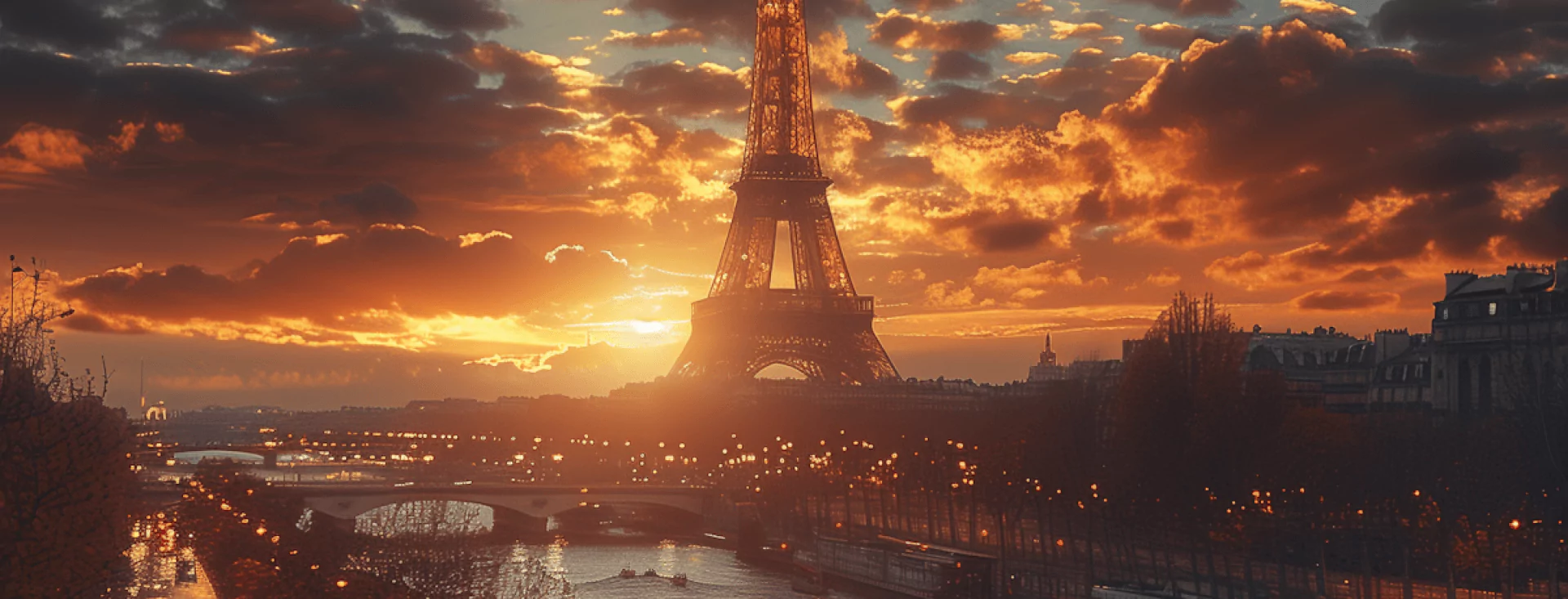
Hemingway carried his love for this city throughout his life, dedicating a novel to it… Here’s how he, in particular, writes about Paris: “Paris never ends, and everyone who lived there remembers it in their own way. We always returned there, no matter who we were and how it changed, no matter how hard or easy it was to get there. Paris is worth it, and you always got back in full for everything you gave to it.” Such was Paris in those distant years when Hemingway was very poor and very happy. And it remains so today….
We offer you a journey in the footsteps of Hemingway through the most exquisite and beautiful districts of Paris.


