









The oldest and richest province of France. French kings give it to the Normans, who conquered France during the arrival of the Varangians in Russia. One of the direct descendants of the first Norman duke is the founder of the English royal dynasty.
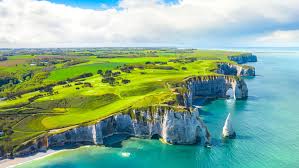
Here lies the trade route from England to Europe, hence the wealth of the province. Beautiful castles, powerful farms, sun-drenched fields, forests, and coastlines – this is what Normandy looks like. Add to this the fashionable resorts where, for example, Belmondo, Brigitte Bardot, or government members, famous couturiers, and various celebrities stroll, include luxurious villas and a swarm of expensive cars, a shining casino, and endless rows of yachts, – and you will get an idea of this region. Not to mention its ancient cities, fish restaurants, culinary specialties, rocky shores, and sandy beaches…
Rouen. Perhaps the most beautiful city in Normandy. About 1500 picturesque Norman houses from the 14th-17th centuries in the “colombage” style. There are also quite a few private mansions from the Renaissance era.
In 1431, Joan of Arc, betrayed by the French king, was burned at his main marketplace. At the execution site – a cross, around which is a flowerbed in the shape of a flame. The modern temple dedicated to the Orléans Maiden is one of the most original in France.
Nearby is another popular monument of Rouen – the Big Clock Tower (La tour du Gros Horloge), built in the early 16th century. The majestic Notre-Dame (Cathédrale Notre-Dame) – a monument of the Gothic era from the 12th-15th centuries. Its facade gained worldwide fame thanks to a series of works by Claude Monet titled “Rouen Cathedral,” most of which is located in the Musée d’Orsay in Paris. The Church of St. Maclou (Église St-Maclou) – a stunning example of Gothic style. Nearby – the Academy of Arts, located in the galleries of probably the only surviving plague cemetery in Europe.
Narrow streets half a meter wide, picturesque ancient houses, powerful Gothic cathedrals – it feels like you have been transported at least 4 centuries back…
Caen. Known since the 1st century. In the 11th century, William the Bastard makes it the capital of the Duchy of Normandy. He asks for the hand of Matilda of Flanders. She responds with an insulting refusal: “I would rather remain an old maid than marry a bastard!”
The duke goes to Lille, seduces Matilda with cunning, force, and persuasion… As a result, the pope is forced to allow this marriage, although the young couple is related by blood. As penance, William and Matilda promise to build two Benedictine monasteries in Caen. A few years later, William conquers England and establishes the first dynasty of English kings. He is now called William the Conqueror.
A powerful fortress was founded in 1060. It is completed over the following centuries. Today, it is fashionable to climb the impressive walls, visit the Museum of Fine Arts, the Museum of Normandy, the ancient chapel of St. George (a monument from the 12th-15th centuries), see the Grand Hall from the 13th century, where kings returning from the Crusades were received…
To the west and east of the fortress are two abbeys – male and female, founded, respectively, by William and Matilda. In the main church of the male monastery rest the remains of William’s burial (burned by Protestants). Queen Matilda was buried in the majestic Church of the Holy Trinity built by her as a vow in the female monastery.
The city itself is beautiful, with a cozy port, ancient streets, remnants of city fortifications, boulevards from the 19th century…


