








Already in the 2nd century, a Roman church stood on the hill. In the 3rd century, the first bishop of the city of Paris, St. Denis, was beheaded here, becoming the patron of French royal dynasties. It was on the site of this execution that, 13 centuries later, Ignatius of Loyola founded the Jesuit order.
Until the end of the 18th century, there were quarries on the hill, where limestone was extracted, which led to a large number of mills processing the extracted raw materials, and some names, for example, the square and street Blanche – “white”, as everything was covered in whitish dust in this area… The quarries were closed, the mills began to turn into restaurants and cabarets, and Montmartre became the center of bohemian life. In the mid-19th century, a new era began here, associated with the names of Heine, Offenbach, and known as the Beautiful Era – Belle Époque.
Interestingly, until this time, i.e., until the mid-19th century, Montmartre remained a village on the outskirts of Paris. And even now, its central square, Place du Tertre, retains typical features of a village square – a square with a building that housed the town hall and the Church of St. Peter (église Saint-Pierre-de-Montmartre). It has preserved columns from the pagan church of the 2nd century and the tomb of Queen Louise of Savoy (12th century), who founded a women’s Benedictine monastery here. In the 17th century, it was in this monastery that the Catholic cult of the Sacred Heart of Christ (Basilique du Sacré Cœur) was born, to which a cathedral of the same name was dedicated at the beginning of our century.
Many famous personalities are buried in Montmartre Cemetery: Vaslav Nijinsky, Alexandre Dumas fils, Heinrich Heine, Hector Berlioz, Edgar Degas, Jacques Offenbach, and others. But to this day, cafes and houses that have seen not only them but also the entire literary and artistic world of Paris at the turn of the 19th and 20th centuries are still alive.
On the slopes of the hill, the famous vineyards of Montmartre have been preserved, next to which stand houses entwined with grapes and ivy. Here lived Auguste Renoir, Vincent van Gogh, Paul Verlaine, Pablo Picasso… Now thousands of tourists admire the picturesque corners, street artists, clowns, jugglers… It seems that Montmartre has turned into a huge open-air theater, where instead of a buffet and foyer – famous cabarets and restaurants, theaters, discos, museums…
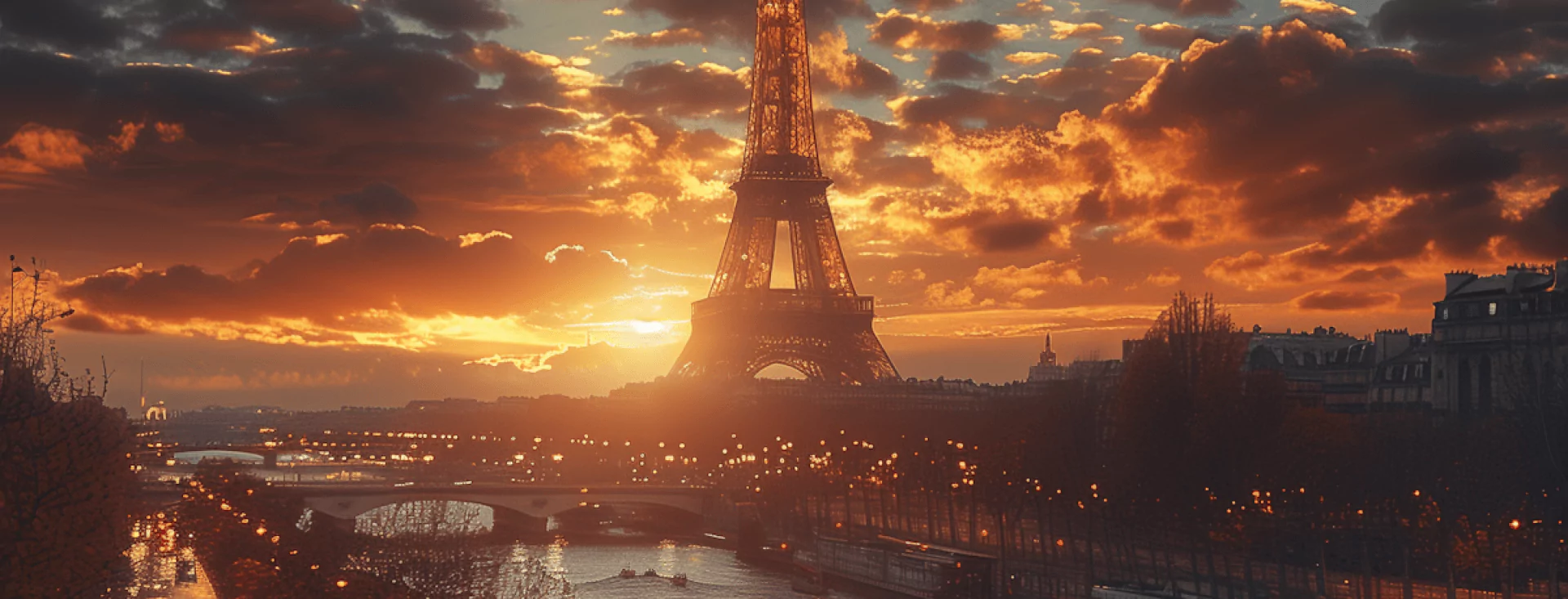
From the viewing platform, which is the highest point in Paris, a breathtaking view of the city opens up: Notre-Dame Cathedral, the Opera, the Louvre, the Orsay Museum, Place de la Concorde, the Arc de Triomphe, the Eiffel Tower – the whole city lies before you.
At the foot of the hill is one of the centers of the city’s nightlife – lap and peep shows, sex shops, bars with girls, an erotic museum, erotic theaters.
Here is also a whole series of famous cabarets: Moulin Rouge, New Eva, Lapin Agile, and others. Among the restaurants are many known for their selection of seafood, and theaters, discos are located right here…


